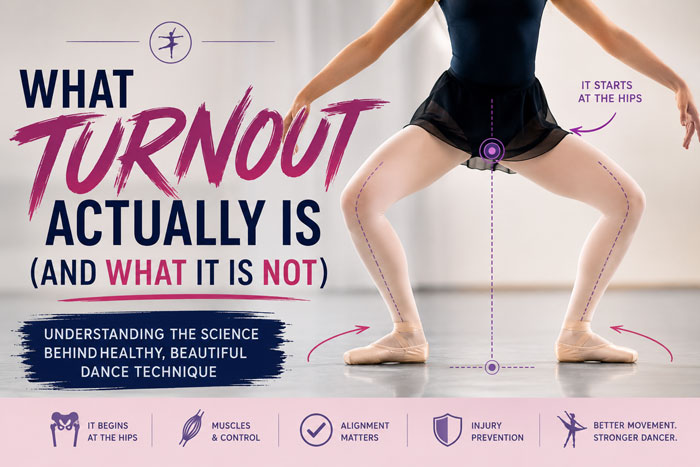
Turnout is one of the most recognizable concepts in dance. Even people with little dance experience often associate ballet and many other dance styles with dancers standing with their feet turned outward. Yet despite how common turnout is in dance training, it is also one of the most misunderstood concepts among students, parents, and sometimes even young instructors.
Many dancers grow up hearing phrases like “turn out more” or “use your turnout,” but without fully understanding what turnout actually means biomechanically. As a result, dancers sometimes attempt to force turnout from the knees, ankles, or feet rather than developing healthy rotation from the hips where turnout truly originates.
Understanding turnout properly is important not only for technique and aesthetics, but also for long-term movement efficiency and injury prevention.
Download the Dance Turnout Info Guide (PDF).
Turnout Begins at the Hip Joint
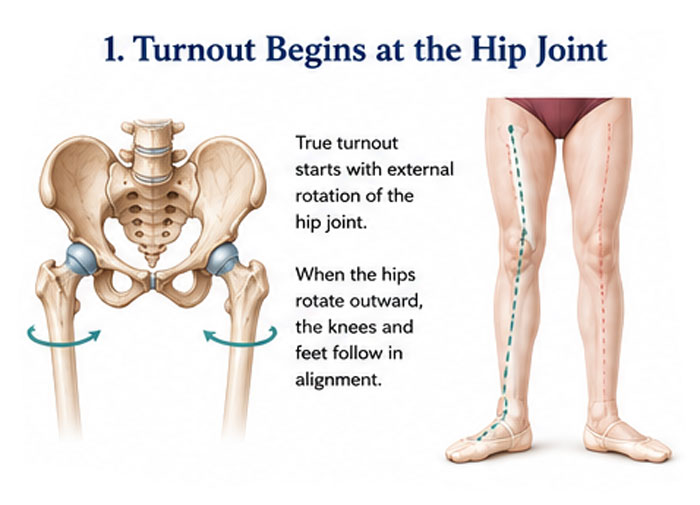
True turnout is primarily created through external rotation of the hip joint. In simple terms, this means the thigh bone rotates outward within the hip socket.
The hips are designed to allow a wide range of motion, including rotation. Some dancers naturally possess greater hip external rotation due to their anatomy, while others may have more limited rotational capacity. This variation is normal and largely influenced by bone structure, ligament flexibility, muscle balance, and individual anatomy.
What is important to understand is that turnout does not truly begin in the feet. It also does not originate in the knees. The hips are the primary source of healthy turnout.
When dancers rotate correctly from the hips, the knees and feet generally align with the direction of the thighs. This creates cleaner alignment throughout the lower body and allows movement to distribute more naturally through the legs.
What Turnout Is Not
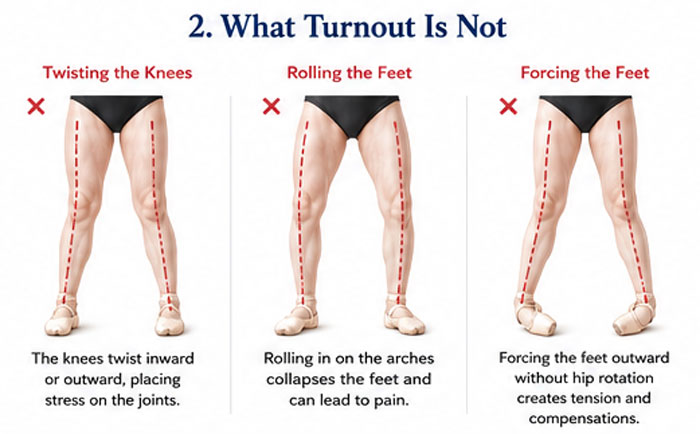
One of the biggest misconceptions in dance training is that turnout simply means placing the feet farther apart or forcing the toes outward as much as possible.
In reality, forcing the feet outward without proper hip rotation can create significant stress throughout the body.
For example, some dancers attempt to increase turnout by twisting at the knees or collapsing the arches of the feet. Others may tilt the pelvis or grip excessively in the lower back in an attempt to create a more dramatic outward position. While these compensations may temporarily create the appearance of greater turnout, they are not examples of healthy rotational mechanics.
Turnout is also not a competition to see who can achieve a perfect 180-degree position. The ideal amount of turnout varies from dancer to dancer because every body is built differently.
A dancer with moderate but properly aligned turnout often demonstrates stronger technique and healthier movement patterns than a dancer who forces excessive turnout through compensations.
Anatomy Plays a Bigger Role Than Many Realize
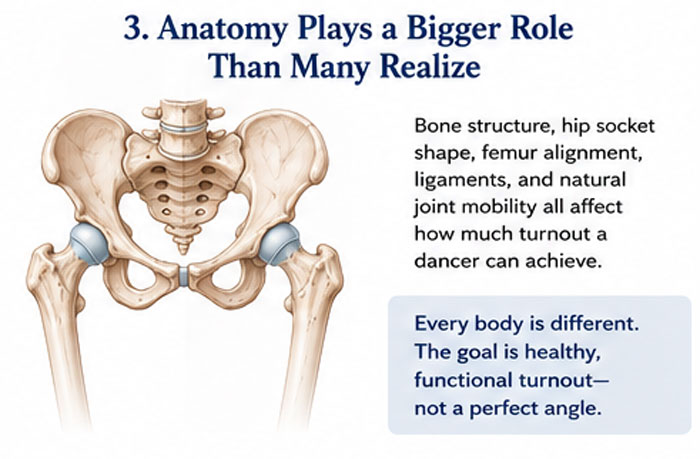
In the dance world, turnout is sometimes discussed as though it is purely the result of hard work or stretching. While training absolutely matters, anatomy also plays a major role.
The shape of the hip socket, the angle of the femur, ligament structure, and natural joint mobility all influence how much external rotation a dancer can comfortably achieve.
This means two dancers working equally hard may still have very different natural turnout capacities.
That can sometimes be frustrating for students, especially in highly competitive environments. However, understanding anatomical individuality is important because it encourages dancers to focus on developing their healthiest possible turnout rather than chasing unrealistic expectations.
Good dance training should help dancers maximize their individual potential safely rather than forcing every body toward the exact same aesthetic outcome.
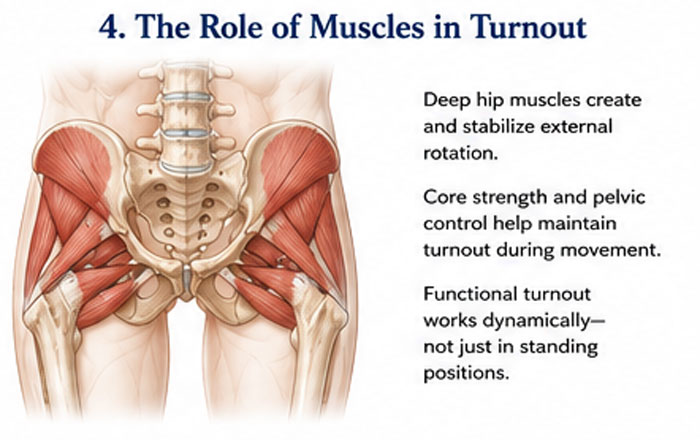
The Role of Muscles in Turnout
Although bone structure affects turnout capacity, muscular control also plays a major role in how turnout functions during movement.
Several deep hip muscles help create and stabilize external rotation. Core stability and pelvic control also influence how effectively dancers can maintain turnout while balancing, jumping, turning, or transitioning through choreography.
This is why turnout is not merely a static position. Functional turnout must work dynamically during movement.
A dancer standing still in first position may appear to have strong turnout, but maintaining healthy alignment during combinations, jumps, and directional changes requires strength, coordination, and control throughout the body.
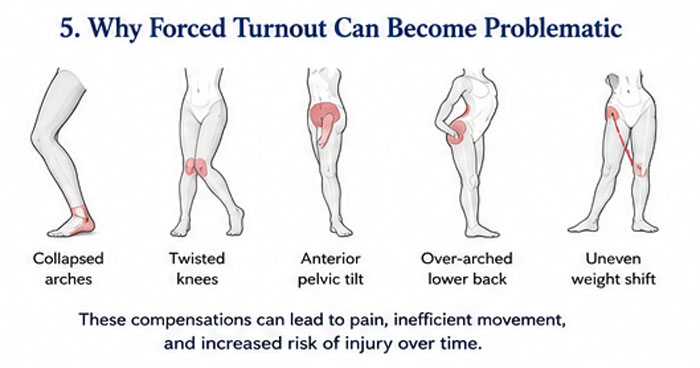
Why Forced Turnout Can Become Problematic
When turnout is forced beyond a dancer’s natural hip rotation capacity, the body often finds compensation patterns elsewhere.
Some common compensations include:
- rolling inward on the arches of the feet
- twisting the knees
- gripping the glutes excessively
- tilting the pelvis forward
- over-arching the lower back
- shifting weight unevenly
Over time, these compensations may contribute to inefficient movement patterns and increased stress on joints and connective tissues.
This does not mean dancers should fear turnout training. Rather, it highlights the importance of developing turnout progressively, with attention to alignment and muscular control instead of simply pushing for larger angles.
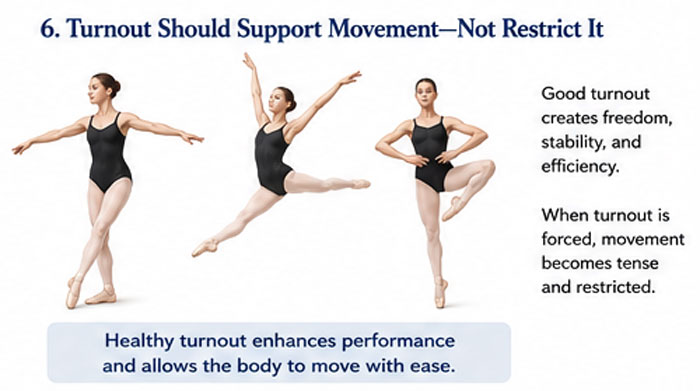
Turnout Should Support Movement – Not Restrict It
One of the goals of good turnout is to create greater freedom and efficiency of movement.
Proper turnout can help facilitate:
- cleaner lines
- improved balance
- smoother directional changes
- better movement initiation
- increased stability during certain technical elements
However, turnout should never become so forced that it limits mobility, creates tension, or interferes with natural movement quality.
Ironically, dancers who obsess over maximizing turnout at all costs sometimes end up moving less freely because the body becomes overly tense and mechanically restricted.
Healthy technique usually involves a balance between rotation, strength, flexibility, coordination, and ease of movement.
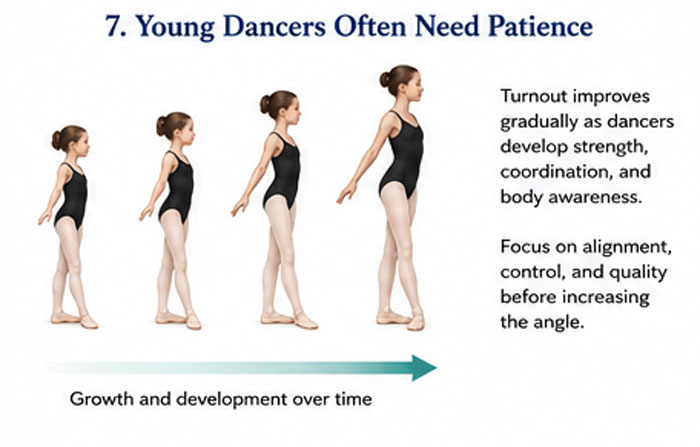
Young Dancers Often Need Patience
Younger dancers are still developing physically, and their coordination, strength, and body awareness continue evolving throughout adolescence.
Because of this, turnout often improves gradually over time as dancers develop:
- stronger hip stabilizers
- better core control
- improved posture
- greater body awareness
- more refined movement mechanics
Trying to aggressively force turnout too early can sometimes encourage poor habits that become difficult to correct later.
Many experienced instructors focus first on alignment, control, and movement quality before emphasizing larger turnout angles.
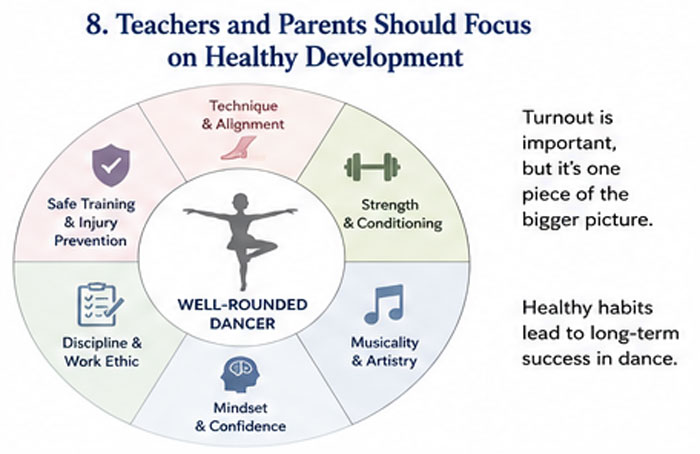
Teachers & Parents Should Focus on Healthy Development
For dance teachers and parents, it is important to remember that turnout is only one part of a dancer’s overall development.
Musicality, artistry, coordination, rhythm, strength, performance quality, discipline, and confidence all contribute to successful dancing. A student with safe, controlled turnout and excellent movement quality is often in a stronger long-term position than a student who forces extreme positions prematurely.
Encouraging healthy movement habits early can help dancers build more sustainable technique over time.
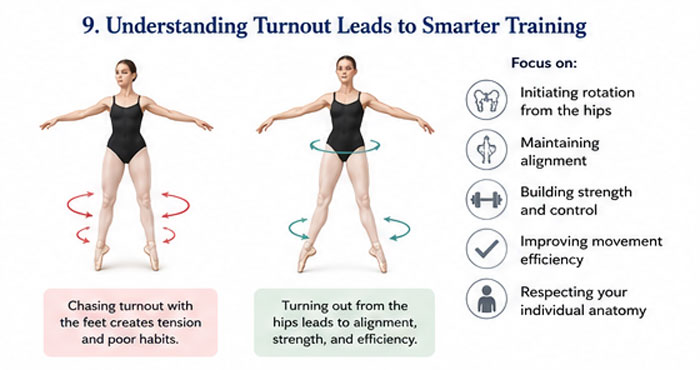
Understanding Turnout Leads to Smarter Training
When dancers understand what turnout truly is, they often begin approaching training differently.
Instead of chasing the appearance of turnout by twisting the feet outward, dancers can focus on:
- initiating rotation from the hips
- maintaining alignment
- building strength and control
- improving movement efficiency
- respecting their individual anatomy
That shift in understanding can lead to healthier technique, improved body awareness, and more sustainable development throughout a dancer’s training journey.
This article is intended for educational purposes related to dance training and movement mechanics. It is not medical advice or a substitute for professional medical evaluation or treatment.
Leave a Reply