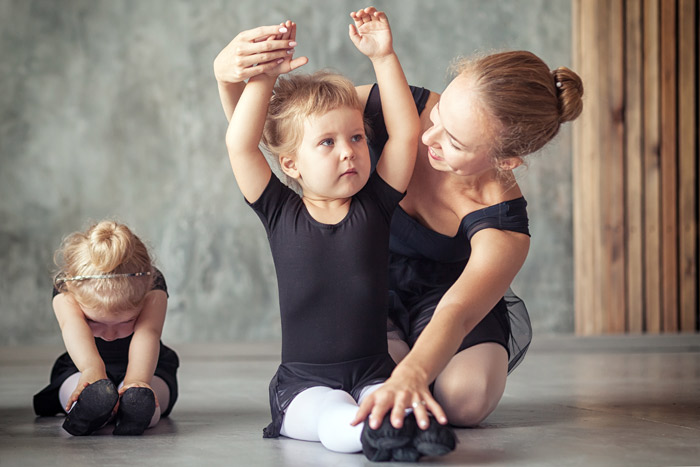
Tiny ballet shoes. Sparkly tutus. A stage full of wiggly 3- and 4-year-olds waving at their parents instead of watching the teacher.
Preschool dance is adorable – but it’s also often misunderstood.
Many parents quietly wonder:
Is my child learning enough?
Should she already know her positions?
Why isn’t the class more “structured”?
If you have a preschooler in dance, here’s the reassuring truth:
At this age, the most important skills aren’t perfect pliés or pointed toes.
They’re much bigger than that.
Attention & Listening Skills
For children ages 3–5, simply participating in a structured group activity is a developmental milestone.
Learning to:
- Stand in a line
- Wait for a turn
- Follow multi-step directions
- Freeze when the music stops
These are foundational life skills.
A preschool dance class helps children practice listening to an adult who isn’t a parent, responding to cues, and transitioning between activities. These skills directly support kindergarten readiness.
If your child can enter the studio, separate from you, and engage for 30–45 minutes, that’s growth worth celebrating.
Coordination & Body Awareness
At this stage, children are still figuring out how their bodies move in space.
Preschool dance develops:
- Balance
- Basic motor planning
- Spatial awareness
- Bilateral coordination (using both sides of the body)
When a child skips across the floor, tiptoes in a circle, or practices marching to music, she is building neural pathways that support future athletic and academic success.
Perfect turnout or textbook arm placement is not the goal.
Learning how to control arms and legs intentionally – even imperfectly – is.
Rhythm & Musicality
Preschoolers are naturally musical. They bounce, clap, and spin instinctively when they hear a song.
Dance classes help refine that instinct into awareness.
Children learn to:
- Move fast and slow
- Recognize different tempos
- Start and stop with music
- Match movements to rhythm
These early musical foundations support not only dance but language development as well. Rhythm and speech patterns are closely connected in early childhood learning.
If your child can clap along or freeze dramatically when the music pauses, important developmental work is happening.
Imagination & Creative Expression
You may notice that preschool dance often includes pretending to be butterflies, princesses, puppies, or snowflakes.
This is not “filler.” It’s purposeful.
Imaginative movement builds creativity, emotional expression, and storytelling skills. At this age, children understand concepts better through imagery than technical vocabulary.
When a teacher says, “Reach your arms like you’re picking apples,” the child connects physically and cognitively.
Creativity at this stage matters more than technical precision.
Social Development
Preschool dance is often one of a child’s first group experiences outside the home.
In class, they learn to:
- Share space
- Take turns
- Respect classmates
- Participate in group choreography
Even standing on stage during a recital – whether they perform every step or not – builds courage.
Shyness, distraction, or occasional tears are normal at this age. Growth isn’t linear.
What matters is gradual comfort in a social learning environment.
Emotional Confidence
One of the most important outcomes of preschool dance is confidence.
When children master a simple sequence and hear applause, their sense of accomplishment grows.
Even small victories – remembering a routine, balancing for three seconds, walking onto stage independently – build resilience.
Confidence at this age doesn’t come from technical mastery. It comes from trying something new and being supported in the process.
What Doesn’t Matter (Yet)
It’s important to gently release unrealistic expectations.
Preschoolers do not need:
- Perfectly straight knees
- High extensions
- Advanced terminology
- Strict technical drills
- Multiple classes per week
Organizations such as the American Academy of Pediatrics consistently emphasize that early childhood sports and activities should focus on fun, exploration, and general motor development – not specialization.
Overly rigid technique training at ages 3–5 can actually dampen enthusiasm.
There will be plenty of time later for refinement.
Signs of a Healthy Preschool Dance Class
A developmentally appropriate class will include:
- Movement variety
- Age-appropriate music
- Short activity segments (to match attention spans)
- Encouragement rather than heavy correction
- Clear but gentle structure
You may see wiggles, giggles, and occasional wandering attention. That’s normal.
The goal isn’t perfection. It’s participation.
Should My Preschooler Take Multiple Classes?
For most children in this age group, one class per week is more than enough.
Preschoolers benefit from diverse movement experiences – playground play, climbing, running, jumping, swimming – rather than specializing in one activity.
Dance should complement childhood, not consume it.
If your child asks for more dance because she loves it, consider adding a creative movement class rather than doubling technical ballet.
The Long-Term Perspective
Parents sometimes worry that if their child isn’t “ahead” in preschool, she’ll fall behind later.
The truth is that early technical advancement does not predict long-term success in dance.
A child who develops strong coordination, joy in movement, and confidence at age 4 is often better prepared for serious training at age 8 than one who was pushed too hard too early.
Preschool dance plants seeds. It doesn’t build finished products.
The Bottom Line
So what skills actually matter in preschool dance?
Listening.
Coordination.
Rhythm.
Imagination.
Social growth.
Confidence.
If your child leaves class smiling, moving more confidently, and excited to return next week, she’s learning exactly what she needs to learn.
The tiny tutu phase is about joy – not perfection.
And that joy is the foundation for everything that comes next.
Leave a Reply