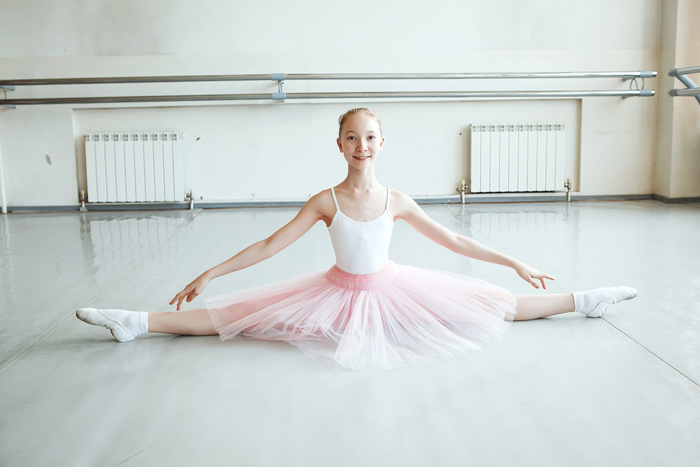
If you’re the parent of a dancer, you’ve probably seen it: splits in the living room, oversplits against the couch, a foot propped up on the kitchen counter “just to stretch.”
Flexibility is highly valued in dance. High extensions, deep backbends, and beautiful lines are often celebrated on stage and social media. It’s easy to assume that more stretching equals better technique.
But here’s the truth: more stretching is not always better – and sometimes it’s not safe.
Understanding what actually supports a dancer’s body (and what can quietly cause harm) is essential for protecting long-term health.
Flexibility vs. Mobility: They’re Not the Same
Many people use the words flexibility and mobility interchangeably, but they are different.
Flexibility refers to how far a muscle can lengthen. Mobility refers to how well a joint can move with strength and control.
In dance, mobility matters more than passive flexibility.
A dancer who can slide into a flat split but cannot hold her leg at 90 degrees without gripping is missing strength in the end range. That imbalance increases injury risk.
Organizations like the International Association for Dance Medicine & Science emphasize that flexibility must be paired with muscular stability. Otherwise, joints become vulnerable.
The goal is not extreme range. The goal is controlled range.
The Risk of Overstretching
Children and teens are often naturally flexible. Growth plates are still developing, and connective tissues may be more elastic.
This can create a dangerous illusion: because a stretch feels easy, it must be safe.
But overstretching can lead to:
- Joint instability
- Muscle strains
- Hip impingement
- Stress injuries
- Chronic pain
Oversplits (placing the front foot on a raised surface) are particularly risky for young dancers whose hips are still forming. Forcing turnout by pushing knees down or twisting ankles to achieve more rotation can also strain ligaments.
Pain is not progress.
If a stretch causes sharp discomfort, pinching in the hip, tingling, or lingering soreness the next day, it’s a red flag.
Static Stretching: When Is It Appropriate?
Static stretching – holding a stretch for 20–60 seconds – has its place.
However, it is most appropriate:
- After class
- When muscles are warm
- As part of a cool-down routine
Holding deep stretches before class, when muscles are cold, may temporarily reduce strength and power output. For dancers preparing to jump or turn, this can actually increase injury risk.
Instead, pre-class routines should emphasize gentle, dynamic movement that gradually increases range.
Dynamic Stretching: A Safer Warm-Up
Dynamic stretching involves controlled, moving stretches rather than long holds.
Examples include:
- Leg swings with control
- Gentle lunges with arm movement
- Controlled développés
- Slow spinal articulations
Dynamic stretching increases blood flow, activates muscles, and prepares joints for movement.
It reinforces strength within range – which is exactly what dancers need.
Hyperflexible Dancers Need Strength, Not More Stretching
Some dancers are naturally hypermobile. They can easily achieve splits, extreme backbends, or winged feet.
Parents often assume these dancers should stretch even more to capitalize on their flexibility.
In reality, hypermobile dancers are at greater risk of instability injuries. Their ligaments already allow significant range. What they need most is strengthening the muscles that support their joints.
If your child frequently complains of “popping” hips, rolling ankles, or feeling unstable in balances, excessive stretching may be contributing.
Strength training – especially for the core, hips, and ankles – is often more beneficial than another split session.
Forcing Turnout Is Never Safe
Turnout should originate from the hips – not the knees or ankles.
When dancers force turnout by twisting their lower legs or pushing their knees downward in a butterfly stretch, they strain ligaments that are not designed for rotation.
Over time, this compensation can cause knee pain or ankle instability.
Safe turnout development comes from strengthening the deep external rotators of the hip, not from pushing range passively.
If a dancer cannot maintain turnout while standing without gripping or rolling in the arches, more stretching will not solve the issue.
Growth Spurts Change Everything
During growth spurts, bones lengthen rapidly. Muscles often lag behind, creating temporary tightness and coordination challenges.
Parents sometimes respond by encouraging extra stretching.
While gentle stretching can help relieve discomfort, aggressive stretching during growth spurts may increase strain on vulnerable areas.
The American Academy of Pediatrics advises that youth athletes experiencing growth changes should focus on gradual conditioning and avoid excessive repetitive strain.
Patience is key. Coordination and flexibility often rebalance naturally as the body adjusts.
Red Flags Parents Should Watch For
Stretching should never cause:
- Sharp or stabbing pain
- Numbness or tingling
- Joint swelling
- Pain that persists into the next day
- A feeling of instability
If these occur, it may be time to consult a dance-informed medical professional.
Encourage your dancer to communicate honestly about discomfort. Many young dancers believe pain is simply part of improving. It’s not.
What Safe Stretching Looks Like
Safe stretching for dancers includes:
- Warming up before deep range work
- Using active flexibility exercises
- Strengthening muscles around mobile joints
- Avoiding forced oversplits
- Limiting passive holds to appropriate durations
- Prioritizing alignment over depth
Stretching should feel like gentle tension – not distress.
The Bigger Picture
Flexibility is only one ingredient in strong dance technique.
Balance, strength, coordination, musicality, and endurance all matter just as much. A dancer with moderate flexibility and excellent control often performs more beautifully – and more safely – than one with extreme but unstable range.
As a parent, your role is not to encourage deeper splits at any cost.
It’s to protect your dancer’s growing body.
Because the truth about stretching is simple:
The safest flexibility is the kind your dancer can control.
And control – not extremity – is what creates lasting artistry.
Leave a Reply